
Login or create an account
CloseReturning Customer
I am a returning customer
Login or create an account
CloseRegister Account
If you already have an account with us, please login at the login form.
Your Account Has Been Created!
Thank you for registering with researchpeptidessale!
You will be notified by e-mail once your account has been activated by the store owner.
If you have ANY questions about the operation of this online shop, please contact the store owner.
Account Logout
You have been logged off your account. It is now safe to leave the computer.
Your shopping cart has been saved, the items inside it will be restored whenever you log back into your account.
Research Overview
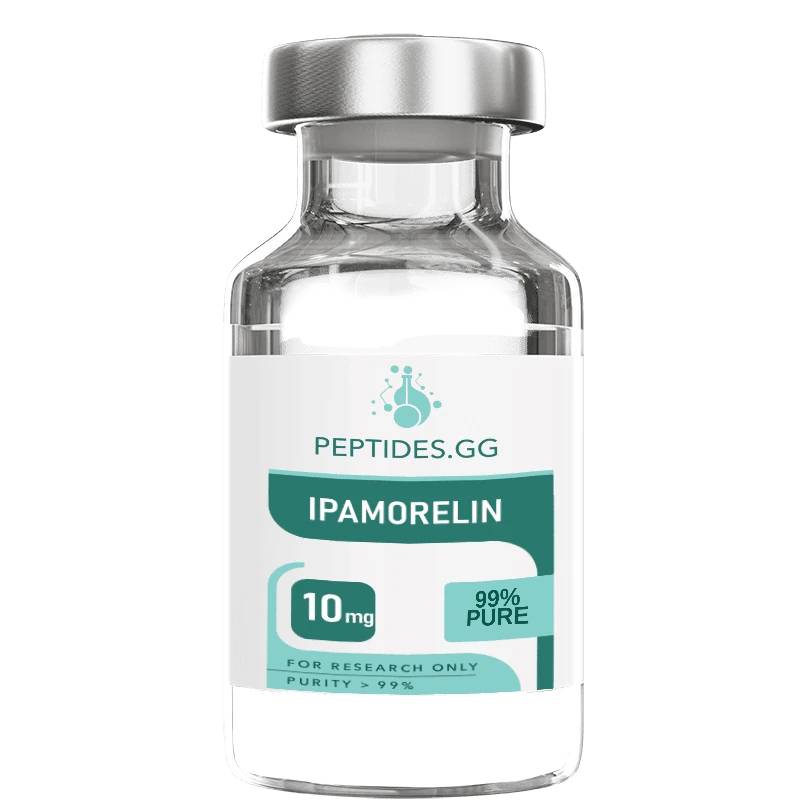
The Ipamorelin peptide serves as a valuable research tool for investigating selective growth hormone secretagogue receptor (GHSR) activation and specific GH release mechanisms in laboratory settings. This synthetic pentapeptide represents a significant advancement in GHRP development, with structural modifications designed to maximize GH-releasing potency while minimizing undesired activation of ACTH/cortisol and prolactin pathways. Research applications have expanded to encompass investigations of ghrelin receptor pharmacology, selective signaling pathway activation, and synergistic interactions with GHRH analogs.
The peptide’s development as a fifth-generation GHRP addressed limitations of earlier compounds including GHRP-6, GHRP-2, and Hexarelin, which demonstrated varying degrees of non-selective pathway activation. Ipamorelin’s unique structure, incorporating synthetic amino acids including aminoisobutyric acid (Aib) at the N-terminus and D-isomers at positions 3 and 4, confers both metabolic stability and highly selective receptor activation. Laboratory studies investigate Ipamorelin’s effects on pulsatile GH secretion, concentration-response relationships, and receptor signaling cascades.
Ipamorelin research demonstrates the peptide’s ability to stimulate robust GH release through specific GHSR-1a activation without the hunger-stimulating effects associated with ghrelin or the cortisol elevation observed with some earlier GHRPs. This selectivity profile makes Ipamorelin particularly valuable for isolating GH-specific effects from confounding hormonal changes in research protocols. Growth hormone secretagogue research employs multiple GHSR agonists including GHRP-2 and GHRP-6, which exhibit broader receptor engagement and additional effects on appetite and cortisol, enabling comparative selectivity studies.
Molecular Characteristics
Complete Specifications:
- CAS Registry Number: 170851-70-4
- Molecular Weight: 711.85 Da
- Molecular Formula: C₃₈H₄₉N₉O₅
- Sequence: Aib-His-D-2-Nal-D-Phe-Lys-NH₂
- Peptide Classification: Synthetic pentapeptide, growth hormone secretagogue
- Appearance: White to off-white lyophilized powder
- Solubility: Water, bacteriostatic water, phosphate buffered saline
The peptide’s compact five-amino acid structure incorporates several key modifications that contribute to its unique properties. Aminoisobutyric acid (Aib) at position 1 confers N-terminal stability against aminopeptidase degradation. D-2-naphthylalanine (D-2-Nal) at position 3 and D-phenylalanine (D-Phe) at position 4 provide protease resistance and contribute to receptor binding affinity. The C-terminal lysine is amidated (Lys-NH₂), preventing C-terminal degradation by carboxypeptidases. This combination of modifications results in enhanced metabolic stability while maintaining specific GHSR-1a activation.
Pharmacokinetic Profile in Research Models
Ipamorelin pharmacokinetic characterization in preclinical research reveals important properties for experimental design:
Absorption and Half-Life:
- Plasma half-life: Approximately 2 hours following IV or SC administration
- Sufficient duration for pulsatile GH stimulation in research models
- Rapid absorption following subcutaneous administration
- Bioavailability comparable across multiple administration routes
GH Stimulation Dynamics:
- Rapid GH elevation following administration (peak within 30-45 minutes)
- concentration-dependent GH release response
- Duration of GH elevation: 2-3 hours
- Return to baseline enabling repeat administration for pulsatile stimulation studies
Selectivity Profile:
- Minimal ACTH/cortisol stimulation (major advantage over earlier GHRPs)
- No significant prolactin elevation at GH-releasing amounts
- Minimal impact on appetite/ghrelin-related feeding behavior
- Selective GHSR-1a activation without broad ghrelin mimetic effects
These pharmacokinetic characteristics inform research protocol design, particularly for investigating selective GH effects independent of confounding hormonal changes. The moderate half-life enables multiple daily administration while maintaining pulsatile rather than sustained GH elevation.
Research Applications
Selective GH Secretion Studies
Ipamorelin serves as a research tool for investigating specific GH release mechanisms. Laboratory studies examine the peptide’s effects on:
- GHSR-1a Pharmacology: Investigation of ghrelin receptor subtype selectivity, binding kinetics, and signal transduction specificity
- Pulsatile GH Release Research: Analysis of GH secretory pulse amplitude, frequency, and pattern modulation
- concentration-response Relationships: Studies characterizing GH release as a function of Ipamorelin concentration
- Somatotroph Cell Function: Research on pituitary somatotroph responsiveness and intracellular signaling pathways
- Selectivity Mechanism Studies: Investigation of molecular basis for selective GH release without ACTH/prolactin activation
Research protocols typically employ in vitro pituitary cell systems, ex vivo pituitary explants, and in vivo animal models to characterize Ipamorelin’s selective GH-releasing properties.
Synergistic GH Axis Research
Substantial research focuses on synergistic pathway investigation:
- GHRH + GHRP Synergy Studies: Research on amplified GH release when combining Ipamorelin with CJC-1295 or other GHRH analogs
- Dual Pathway Activation: Investigation of complementary GHRH receptor and ghrelin receptor stimulation
- Synergy Mechanisms: Studies examining intracellular signaling pathway convergence and amplification
- Optimal Combination Ratios: Research determining amount relationships for maximal synergistic effects
- Temporal Synergy Investigation: Studies on timing of combined administration for optimal GH pulse amplification
Laboratory protocols investigate synergistic effects using various GHRH analogs and administration strategies to characterize additive versus synergistic GH release patterns. GHRH analog research utilizes compounds such as Sermorelin and CJC-1295, which amplify existing GH pulses through the GHRH receptor, providing mechanistically complementary stimulation when combined with GHSR agonists.
Body Composition Research Applications
Laboratory studies investigate Ipamorelin in body composition research:
- Fat Mass Regulation Studies: Research on GH-mediated lipolysis, adipose tissue reduction, and fat distribution changes
- Lean Mass Investigation: Studies examining muscle protein synthesis, nitrogen retention, and muscle mass changes
- IGF-1 Mediated Effects: Research on growth factor pathway activation downstream of GH elevation
- Body Composition Remodeling: Investigation of simultaneous fat loss and lean mass preservation or gain
- Regional Fat Distribution: Studies examining visceral versus subcutaneous adipose tissue responses
Experimental models include body composition assessment in animal studies examining changes over multiple weeks of Ipamorelin administration.
Metabolic Pathway Investigation
Research applications extend to metabolic process investigation:
- Glucose Metabolism Studies: Examination of GH effects on glucose uptake, insulin sensitivity, and hepatic glucose production
- Lipid Metabolism Research: Investigation of lipolysis activation, fatty acid oxidation, and lipid profile changes
- Protein Metabolism Studies: Research on protein synthesis rates, amino acid uptake, and nitrogen balance
- Energy Expenditure Investigation: Studies examining metabolic rate changes and substrate utilization shifts
- Metabolic Flexibility Research: Investigation of metabolic adaptation to altered GH/IGF-1 axis activity
Laboratory protocols investigate metabolic effects using indirect calorimetry, glucose/insulin tolerance testing, and metabolic tracer studies in animal models.
Aging and Recovery Research
Emerging research areas include age-related investigation:
- Age-Related GH Decline Studies: Research on restoring GH pulsatility in models of aging-associated GH decline
- Recovery Process Research: Investigation of GH effects on tissue repair, adaptation to training stimuli, and recovery mechanisms
- Sleep Quality Studies: Research examining GH’s role in sleep architecture and recovery processes
- Tissue Maintenance Investigation: Studies on GH effects on tissue homeostasis and cellular turnover
- Functional Capacity Research: Investigation of strength, endurance, and physical function relationships to GH status
Research in this area examines Ipamorelin’s effects in aged animal models and recovery paradigms following various stressors. Growth factor-mediated recovery research also investigates IGF-1 LR3, which acts downstream of GH signaling to directly activate insulin-like growth factor receptor pathways in target tissues.
Laboratory Handling and Storage Protocols
Lyophilized Powder Storage:
- Store at -20°C to -80°C in original sealed vial
- Protect from light exposure and moisture
- Desiccated storage environment recommended
- Stability data available for 24+ months at -20°C
Stability Considerations:
Ipamorelin demonstrates excellent stability as a lyophilized powder due to its synthetic amino acid modifications providing protease resistance. The peptide’s compact structure and D-amino acid content contribute to resistance to enzymatic degradation.
Quality Assurance and Analytical Testing
The analytical methods below are those commonly used to characterize and verify the identity, purity, and quality of research compounds in this class:
Purity Analysis:
- High-Performance Liquid Chromatography (HPLC): ≥99% purity
- Analytical method: Reversed-phase HPLC with UV detection at 214nm
- Multiple peak integration to ensure accurate purity determination
Structural Verification:
- Electrospray Ionization Mass Spectrometry (ESI-MS): Confirms molecular weight 711.85 Da
- Amino acid analysis: Verifies sequence composition including synthetic amino acids
- Peptide content determination: Quantifies actual peptide content by weight
Contaminant Testing:
- Bacterial endotoxin — Limulus amebocyte lysate (LAL) method
- Residual solvents: TFA and acetonitrile within acceptable limits
- Water content: Karl Fischer titration (<8%)
Documentation:
- Certificate of Analysis (COA) provided with each batch
- Third-party analytical verification available upon request
- Stability data documented for recommended storage conditions
- Batch-specific QC results traceable by lot number
Research Considerations
Experimental Design Factors:
Researchers should consider several factors when designing Ipamorelin experiments:
1. concentration Selection: Ipamorelin demonstrates concentration-dependent GH release. Establish concentration-response relationships for specific research objectives and animal models.
2. Timing Considerations: Administer 30-60 minutes before planned GH measurement timepoints. Consider circadian GH patterns when designing experimental protocols.
3. Combination Studies: Ipamorelin + CJC-1295 (No DAC) is a commonly investigated combination for examining synergistic GH release. Determine optimal ratios and timing.
4. Frequency Considerations: The moderate half-life enables 2-3 daily administrations for investigating effects of enhanced pulsatile GH patterns.
5. Selectivity Advantage: Ipamorelin’s lack of cortisol/prolactin elevation enables cleaner interpretation of GH-specific effects compared to less selective GHRPs.
Mechanism Investigation:
Ipamorelin’s mechanisms are well-characterized:
- Selective GHSR-1a (ghrelin receptor) agonism
- Gq/11 protein-coupled signaling activation
- Phospholipase C activation and intracellular calcium mobilization
- Synergistic interaction with GHRH receptor pathway at intracellular signaling level
- Minimal desensitization with intermittent administration patterns
The peptide’s selectivity enables investigation of ghrelin receptor signaling independent of broader ghrelin mimetic effects.
Compliance and Safety Information
Regulatory Status:
Ipamorelin is provided as a research chemical for in-vitro laboratory studies and preclinical research only. This product has not been approved by the FDA for human therapeutic use, dietary supplementation, or medical applications.
Intended Use:
- In-vitro cell culture studies
- In-vivo preclinical research in approved animal models
- Laboratory investigation of biological mechanisms
- Academic and institutional research applications
NOT Intended For:
- Human consumption or administration
- Therapeutic treatment or diagnosis
- Dietary supplementation
- Veterinary therapeutic applications without appropriate oversight
Safety Protocols:
Researchers should follow standard laboratory safety practices when handling Ipamorelin:
- Use appropriate personal protective equipment (lab coat, gloves, safety glasses)
- Handle in well-ventilated areas or fume hood
- Follow institutional biosafety guidelines
- Dispose of waste according to local regulations for biological/chemical waste
- Consult material safety data sheet (MSDS) for additional safety information
—