
Login or create an account
CloseReturning Customer
I am a returning customer
Login or create an account
CloseRegister Account
If you already have an account with us, please login at the login form.
Your Account Has Been Created!
Thank you for registering with researchpeptidessale!
You will be notified by e-mail once your account has been activated by the store owner.
If you have ANY questions about the operation of this online shop, please contact the store owner.
Account Logout
You have been logged off your account. It is now safe to leave the computer.
Your shopping cart has been saved, the items inside it will be restored whenever you log back into your account.
Research Overview
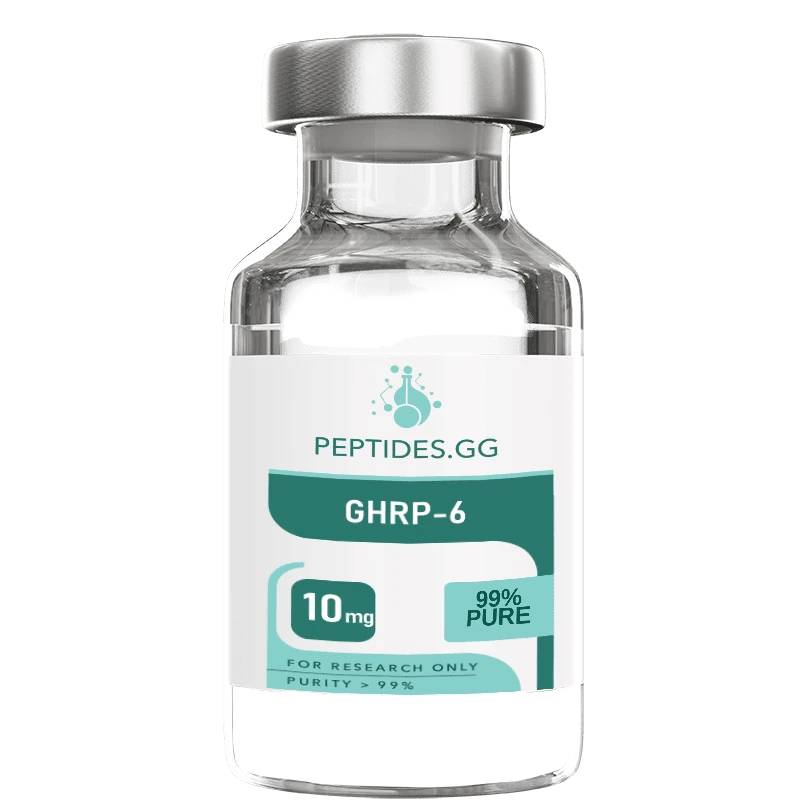
The GHRP-6 peptide serves as a valuable research tool for investigating ghrelin receptor system biology and growth hormone secretagogue mechanisms in laboratory settings. This synthetic hexapeptide represents one of the first successful GHRP compounds developed for research applications, with a structure incorporating D-amino acids for enhanced metabolic stability. Research applications have expanded beyond GH secretion studies to encompass investigations of appetite regulation, gastric motility, cardiac function, and anti-inflammatory pathways associated with ghrelin receptor activation.
The peptide’s development in the 1980s marked a significant advance in understanding GH secretion regulation. GHRP-6 acts through the growth hormone secretagogue receptor (GHSR-1a), the endogenous receptor for ghrelin. Unlike more selective newer GHRPs, GHRP-6 activates multiple pathways associated with ghrelin receptor stimulation including hunger, gastric acid secretion, and gastrointestinal motility. Laboratory studies investigate GHRP-6’s effects on pulsatile GH release, synergistic interactions with GHRH, and broader ghrelin system biology.
GHRP-6 research demonstrates the peptide’s potent GH-releasing activity while also activating hunger and feeding-related pathways. This characteristic distinguishes it from selective GHRPs and makes it valuable for investigating the full spectrum of ghrelin receptor-mediated effects. Studies examine the peptide’s effects in cell culture systems, tissue preparations, and preclinical animal models assessing both GH axis and metabolic outcomes.
Molecular Characteristics
Complete Specifications:
- CAS Registry Number: 87616-84-0
- Molecular Weight: 872.44 Da
- Molecular Formula: C₄₆H₅₆N₁₂O₆
- Sequence: His-D-Trp-Ala-Trp-D-Phe-Lys-NH₂
- Peptide Classification: Synthetic hexapeptide, growth hormone secretagogue
- Appearance: White to off-white lyophilized powder
- Solubility: Water, bacteriostatic water, phosphate buffered saline
The peptide’s six-amino acid structure incorporates D-tryptophan at position 2 and D-phenylalanine at position 5, providing resistance to proteolytic degradation. The presence of two tryptophan residues (positions 2 and 4) and their aromatic side chains contribute to receptor binding affinity. The C-terminal lysine is amidated (Lys-NH₂), preventing degradation by carboxypeptidases. This combination of natural and synthetic amino acids creates a metabolically stable peptide with potent GHSR-1a agonist activity.
Pharmacokinetic Profile in Research Models
GHRP-6 pharmacokinetic characterization in preclinical research reveals important properties for experimental design:
Absorption and Half-Life:
- Plasma half-life: Approximately 20-30 minutes following IV or SC administration
- Rapid absorption following subcutaneous administration
- Bioavailability demonstrated across multiple administration routes
- Sufficient duration for acute GH stimulation studies
GH Stimulation Dynamics:
- Rapid GH elevation following administration (peak within 15-30 minutes)
- concentration-dependent GH release response
- Synergistic amplification when combined with GHRH analogs
- Return to baseline within 2-3 hours
Broader Biological Effects:
- Appetite stimulation observed in animal models (ghrelin-like effect)
- Gastric acid secretion stimulation
- Gastrointestinal motility effects
- Potential cardiovascular effects observed in some studies
These pharmacokinetic characteristics inform research protocol design. The short half-life requires frequent administration for repeated stimulation studies, while the broader biological activity profile necessitates consideration of appetite and GI effects in experimental interpretation.
Research Applications
Ghrelin Receptor System Investigation
GHRP-6 serves as a research tool for investigating ghrelin system biology. Laboratory studies examine the peptide’s effects on:
- GHSR-1a Pharmacology: Investigation of ghrelin receptor binding, activation, and signal transduction pathways
- GH Secretion Mechanisms: Research on somatotroph cell responsiveness and intracellular signaling cascades
- Appetite Regulation Studies: Analysis of hunger signaling, neuropeptide Y/AGRP neuron activation, and feeding behavior
- Gastric Function Research: Investigation of gastric acid secretion, motility, and ghrelin’s peripheral effects
- Comparative GHRP Studies: Research comparing first-generation GHRP-6 with selective newer compounds
Research protocols employ in vitro receptor assays, pituitary cell cultures, hypothalamic tissue studies, and in vivo animal models to characterize GHRP-6’s diverse biological activities.
Synergistic GH Release Research
Substantial research focuses on synergistic pathway investigation:
- GHRH + GHRP Synergy: Research on amplified GH release through dual GHRH and ghrelin receptor activation
- Synergy Mechanisms: Studies examining intracellular signal convergence and amplification
- Somatostatin Modulation: Investigation of how GHRPs overcome somatostatin-mediated GH suppression
- Pulse Amplitude Research: Studies on GH pulse height augmentation through synergistic stimulation
- Historical Foundation: GHRP-6 established the scientific basis for GHRP+GHRH combination approaches
Laboratory protocols investigate synergistic effects with various GHRH analogs including native GHRH, Sermorelin, CJC-1295, and Tesamorelin.
Metabolic and Body Composition Studies
Laboratory studies investigate GHRP-6 in metabolic research:
- GH-Mediated Lipolysis: Research on adipose tissue lipolysis and fat oxidation pathways
- Appetite and Energy Balance: Studies examining feeding behavior, energy intake, and metabolic regulation
- Glucose Metabolism: Investigation of GH effects on glucose handling and insulin sensitivity
- Body Composition Changes: Research on fat mass and lean mass alterations over extended treatment periods
- IGF-1 Pathway Activation: Studies on growth factor production downstream of GH elevation
Experimental models include metabolic assessment in animal studies with body composition, food intake, and energy expenditure measurements.
Cardiovascular Research Applications
Research applications extend to cardiovascular investigation:
- Cardiac Function Studies: Examination of ghrelin receptor effects on cardiac contractility and output
- Cardioprotection Research: Investigation of protective effects against ischemia-reperfusion injury
- Vascular Function Studies: Research on endothelial function and vascular reactivity
- Heart Failure Models: Studies examining ghrelin system activation in cardiac pathophysiology models
- Anti-inflammatory Effects: Investigation of ghrelin receptor-mediated anti-inflammatory pathways in cardiovascular tissue
Laboratory protocols investigate cardiovascular effects using isolated heart preparations, cardiac cell cultures, and in vivo cardiovascular assessment in animal models.
Anti-Inflammatory and Protective Pathway Research
Emerging research areas include protective mechanism investigation:
- Anti-Inflammatory Signaling: Research on ghrelin receptor-mediated anti-inflammatory pathway activation
- Cytokine Modulation: Studies examining inflammatory mediator regulation
- Tissue Protection Studies: Investigation of protective effects in various injury models
- Oxidative Stress Research: Studies on antioxidant pathway activation and reactive oxygen species reduction
- Immune Function Investigation: Research on immune cell function modulation through ghrelin receptor activation
Research in this area examines GHRP-6’s effects beyond GH secretion, investigating broader ghrelin system biology in protection and inflammation contexts.
Laboratory Handling and Storage Protocols
Lyophilized Powder Storage:
- Store at -20°C to -80°C in original sealed vial
- Protect from light exposure and moisture
- Desiccated storage environment recommended
- Stability data available for 24+ months at -20°C
Stability Considerations:
GHRP-6 demonstrates good stability as a lyophilized powder due to D-amino acid incorporation providing protease resistance. The peptide’s structure provides reasonable metabolic stability for research applications.
Quality Assurance and Analytical Testing
The analytical methods below are those commonly used to characterize and verify the identity, purity, and quality of research compounds in this class:
Purity Analysis:
- High-Performance Liquid Chromatography (HPLC): ≥99% purity
- Analytical method: Reversed-phase HPLC with UV detection at 214nm
- Multiple peak integration to ensure accurate purity determination
Structural Verification:
- Electrospray Ionization Mass Spectrometry (ESI-MS): Confirms molecular weight 872.44 Da
- Amino acid analysis: Verifies sequence composition including D-amino acids
- Peptide content determination: Quantifies actual peptide content by weight
Contaminant Testing:
- Bacterial endotoxin — Limulus amebocyte lysate (LAL) method
- Residual solvents: TFA and acetonitrile within acceptable limits
- Water content: Karl Fischer titration (<8%)
Documentation:
- Certificate of Analysis (COA) provided with each batch
- Third-party analytical verification available upon request
- Stability data documented for recommended storage conditions
- Batch-specific QC results traceable by lot number
Research Considerations
Experimental Design Factors:
Researchers should consider several factors when designing GHRP-6 experiments:
1. Appetite Effects: GHRP-6’s appetite-stimulating effects may confound metabolic studies. Consider food intake monitoring and pair-feeding controls in body composition research.
2. Gastric Effects: Increased gastric acid secretion and motility may affect experimental outcomes in certain paradigms. Consider timing relative to feeding or fasting states.
3. Comparison Studies: GHRP-6 provides valuable comparison to selective GHRPs (Ipamorelin, Hexarelin) for investigating selectivity versus broad ghrelin mimetic effects.
4. Synergy Research: GHRP-6 established synergistic GH release with GHRH. Valuable for mechanistic studies on signal transduction convergence.
5. Historical Context: As a first-generation GHRP, GHRP-6 provides historical foundation for understanding GHRP development and structure-activity relationships.
Mechanism Investigation:
GHRP-6’s mechanisms include:
- GHSR-1a (ghrelin receptor) agonism
- Gq/11-coupled signaling activation
- Phospholipase C activation and calcium mobilization
- Hypothalamic neuropeptide Y/AGRP neuron activation (appetite)
- Synergistic interaction with GHRH pathway at somatotroph level
- Vagal afferent activation (gastric effects)
The peptide’s broad activity profile reflects full ghrelin receptor agonism including central and peripheral effects.
Compliance and Safety Information
Regulatory Status:
GHRP-6 is provided as a research chemical for in-vitro laboratory studies and preclinical research only. This product has not been approved by the FDA for human therapeutic use, dietary supplementation, or medical applications.
Intended Use:
- In-vitro cell culture studies
- In-vivo preclinical research in approved animal models
- Laboratory investigation of biological mechanisms
- Academic and institutional research applications
NOT Intended For:
- Human consumption or administration
- Therapeutic treatment or diagnosis
- Dietary supplementation
- Veterinary therapeutic applications without appropriate oversight
Safety Protocols:
Researchers should follow standard laboratory safety practices when handling GHRP-6:
- Use appropriate personal protective equipment (lab coat, gloves, safety glasses)
- Handle in well-ventilated areas or fume hood
- Follow institutional biosafety guidelines
- Dispose of waste according to local regulations for biological/chemical waste
- Consult material safety data sheet (MSDS) for additional safety information
—