
Login or create an account
CloseReturning Customer
I am a returning customer
Login or create an account
CloseRegister Account
If you already have an account with us, please login at the login form.
Your Account Has Been Created!
Thank you for registering with researchpeptidessale!
You will be notified by e-mail once your account has been activated by the store owner.
If you have ANY questions about the operation of this online shop, please contact the store owner.
Account Logout
You have been logged off your account. It is now safe to leave the computer.
Your shopping cart has been saved, the items inside it will be restored whenever you log back into your account.
Research Overview
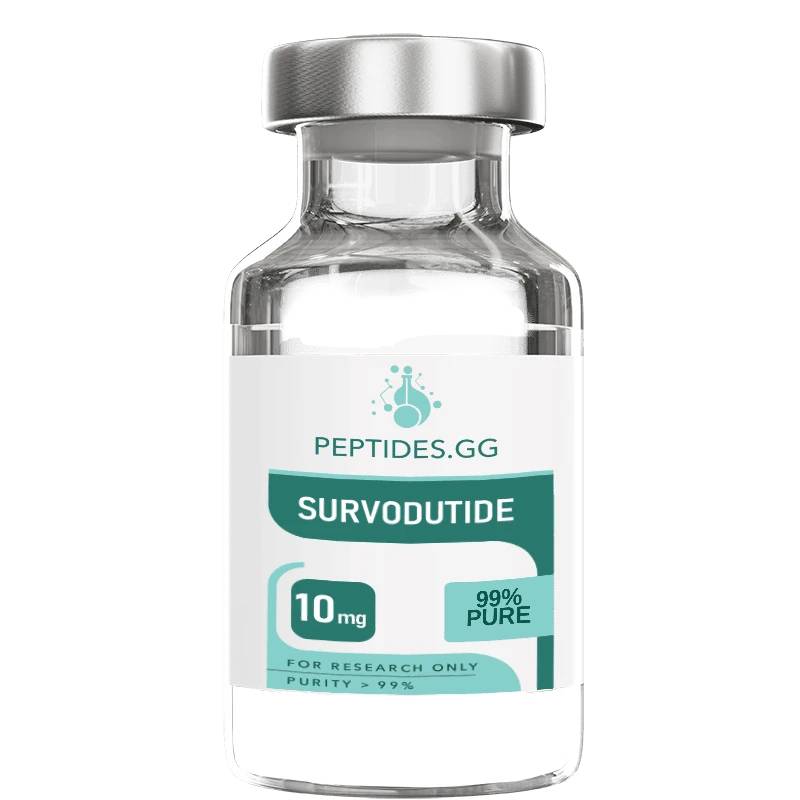
The Survodutide peptide serves as a valuable research tool for investigating simultaneous GLP-1 and glucagon receptor activation as an alternative dual agonist strategy to GLP-1/GIP co-activation. This synthetic peptide enables research into balancing incretin-mediated anabolic effects (insulin secretion, appetite suppression) with glucagon-mediated catabolic effects (enhanced energy expenditure, hepatic lipid oxidation, lipolysis). Research applications encompass dual receptor pharmacology, integrated metabolic regulation, energy balance investigation, and comparative analysis of different multi-hormone receptor activation approaches in experimental systems. Single-receptor reference compounds include Semaglutide for isolated GLP-1R agonism, enabling researchers to quantify the incremental contribution of glucagon receptor engagement.
The peptide represents an important research tool for investigating whether glucagon receptor co-activation with GLP-1R provides superior metabolic outcomes compared to GIP receptor co-activation. This comparison is enabled by compounds like Tirzepatide (GIP/GLP-1 dual agonist) and Retatrutide (GIP/GLP-1/GCGR triple agonist), which provide the multi-receptor pharmacological framework for systematic receptor contribution analysis. Laboratory studies examine survodutide’s effects on glucose homeostasis despite glucagon agonism, enhanced energy expenditure and thermogenesis, hepatic steatosis reduction, adipose tissue lipolysis, and integrated body composition changes. Research protocols investigate the balance between opposing metabolic pathways and net physiological outcomes.
Survodutide research demonstrates the feasibility of combining incretin and counter-regulatory hormone receptor activation within a single molecular entity. The peptide’s structure enables simultaneous high-affinity activation of both GLP-1 and glucagon receptors, with full agonism at the GLP-1 receptor and only partial agonism at the glucagon receptor (a GLP-1R-biased profile). This pharmacological profile makes survodutide a valuable tool for dissecting optimal multi-hormone receptor combinations and understanding integrated metabolic regulation.
Molecular Characteristics
Complete Specifications:
- Molecular Weight: ~4,800 Da (approximate)
- Peptide Classification: GLP-1R/GCGR dual agonist, acylated peptide
- Appearance: White to off-white lyophilized powder
- Solubility: Water, bacteriostatic water, phosphate buffered saline
- Receptor Targets: GLP-1 receptor, Glucagon receptor (GLP-1R-biased dual agonist: full GLP-1R, partial GCGR agonism)
- Modification: Fatty acid acylation, protease-resistant substitutions
The peptide’s molecular architecture represents sophisticated engineering enabling recognition by two structurally related but functionally distinct Class B G-protein coupled receptors. Strategic amino acid substitutions at critical binding interface positions enable dual receptor activation. C-terminal fatty acid acylation provides albumin binding for extended systemic exposure. N-terminal modifications confer DPP-4 resistance. This structure balances GLP-1 and glucagon receptor pharmacophores within a single peptide chain.
Pharmacokinetic Profile in Research Models
Absorption and Distribution:
- Subcutaneous bioavailability: >75% (preclinical models)
- Sustained absorption due to albumin interaction
- Plasma half-life: ~130-150 hours (5-6 days)
- Plasma protein binding: >99%
- Weekly administration potential in chronic studies
Receptor Pharmacology:
- GLP-1R: High potency agonist with robust activation
- GCGR: High potency agonist with robust activation
- Receptor profile: comparable in vitro EC₅₀ at both receptors, but functionally GLP-1R-biased (full GLP-1R activation, partial GCGR activation at therapeutic exposure)
- Differential efficacy: full cAMP response at the GLP-1 receptor, partial (submaximal) response at the glucagon receptor
Elimination:
- Proteolytic degradation pathway
- Renal clearance of peptide fragments
- Steady-state after 4-5 weeks
These properties enable chronic research protocols investigating sustained dual receptor activation over weeks to months.
Research Applications
Dual GLP-1/Glucagon Receptor Pharmacology
Survodutide enables investigation of coordinated GLP-1R and GCGR activation:
- Receptor Synergy Studies: Analysis of combined vs. individual receptor activation effects
- Optimal Activation Ratios: Research on balanced vs. biased dual agonist profiles
- Comparative Dual Agonist Research: Comparison to GLP-1/GIP dual agonists and GLP-1 monotherapy
- Signal Integration: Investigation of cAMP pathway convergence and downstream signaling
- Receptor-Specific Effects: Use of selective antagonists to dissect individual contributions
Research addresses whether GLP-1/glucagon represents an optimal dual agonist combination for metabolic regulation.
Enhanced Energy Expenditure and Thermogenesis
Given glucagon receptor activation, substantial research focuses on energy balance:
- Metabolic Rate Enhancement: Investigation of increased oxygen consumption and energy expenditure
- Brown Adipose Tissue: Examination of BAT activation, UCP1 expression, mitochondrial biogenesis
- Substrate Oxidation: Studies on enhanced fat oxidation and metabolic flexibility
- Physical Activity: Research on spontaneous activity levels and exercise capacity
- Thermogenic Gene Expression: Investigation of thermogenesis-related transcriptional programs
Research investigates whether GCGR-mediated energy expenditure enhancement contributes to superior weight loss beyond appetite suppression alone.
Hepatic Lipid Metabolism and NAFLD Research
Laboratory studies investigate survodutide’s hepatic effects:
- Enhanced Lipid Oxidation: Examination of β-oxidation, CPT1 expression, ketogenesis
- Hepatic Steatosis Reduction: Research on triglyceride clearance and lipid droplet metabolism
- Mitochondrial Function: Studies on hepatic mitochondrial capacity and oxidative metabolism
- NASH Pathology: Investigation of inflammatory markers, fibrosis, hepatocyte health
- Gluconeogenesis Balance: Research on fasting glucose production despite GCGR agonism
Experimental models examine whether glucagon receptor-mediated enhanced hepatic fat oxidation improves NAFLD/NASH outcomes.
Glucose Homeostasis with Glucagon Receptor Activation
Despite glucagon agonism, research investigates glucose regulation:
- Net Glucose Effects: Examination of glucose-lowering despite counter-regulatory receptor activation
- Beta Cell Function: Research on insulin secretion enhancement via GLP-1R
- Glucagon Paradox: Studies on glucagon secretion regulation despite GCGR agonism
- Glucose Tolerance: Investigation of meal-related and fasting glucose regulation
- Hypoglycemia Assessment: Research on glucose nadir and counterregulatory adequacy
Research addresses the critical mechanistic question of maintaining glucose control with balanced dual agonism.
Adipose Tissue Lipolysis and Body Composition
Research applications extend to adipose tissue investigation:
- Enhanced Lipolysis: Examination of glucagon-mediated triglyceride breakdown
- Fat Mass Reduction: Studies on adipose depot reduction kinetics and patterns
- Lean Mass Preservation: Investigation of muscle mass during weight loss
- Adipose Inflammation: Research on inflammatory cytokine expression and resolution
- Browning Phenomena: Studies on beige adipocyte formation in white adipose tissue
Laboratory protocols investigate whether dual GLP-1/glucagon agonism provides superior body composition outcomes.
Cardiovascular and Cardiometabolic Research
Studies investigate cardiovascular effects:
- Cardiac Metabolism: Research on myocardial substrate utilization and efficiency
- Vascular Function: Investigation of endothelial function and arterial health
- Blood Pressure: Studies on natriuresis and hemodynamic regulation
- Lipid Profiles: Examination of triglycerides, cholesterol, lipoprotein particles
- Cardiovascular Risk Markers: Research on biomarkers and risk factor modulation
Experimental models assess cardiovascular outcomes in metabolic disease contexts.
Laboratory Handling and Storage Protocols
Lyophilized Powder Storage:
- Store at -20°C to -80°C in sealed vial
- Protect from light and moisture
- Desiccated environment required
- Stability: 24+ months at -20°C
Quality Assurance and Analytical Testing
The analytical methods below are those commonly used to characterize and verify the identity, purity, and quality of research compounds in this class:
Purity Analysis:
- HPLC: ≥99% purity
- Related substances: <2%
- UV detection at 214nm
Structural Verification:
- ESI-MS: Molecular weight confirmation
- Peptide content: 80-85% (typical)
- Sequence verification by peptide mapping
Contaminant Testing:
- Bacterial endotoxin — Limulus amebocyte lysate (LAL) method
- Residual solvents: Per ICH Q3C
- Water content: <6% (Karl Fischer)
Biological Activity:
- GLP-1R activation: cAMP assay
- GCGR activation: cAMP assay
- Dual agonist profile confirmation
Documentation:
- Certificate of Analysis with complete data
- Batch traceability by lot number
- Third-party verification available
Research Considerations
Experimental Design:
1. concentration Optimization: Balance GLP-1R and GCGR activation to achieve desired metabolic profile without hyperglycemia
2. Glucose Monitoring: Essential throughout studies due to glucagon receptor agonism
3. Comparator Selection:
- GLP-1 selective agonist (semaglutide)
- GLP-1/GIP dual agonist (tirzepatide)
- Other GLP-1/glucagon dual agonist (mazdutide)
4. Mechanism Dissection: Use selective antagonists (GLP-1R antagonist exendin 9-39, GCGR antagonist) or receptor knockout models
5. Temporal Considerations: Acute glucagon effects differ from chronic integrated outcomes
Mechanism Investigation:
- GLP-1R Pathway: Insulin secretion, appetite suppression, beta cell protection, delayed gastric emptying
- GCGR Pathway: Enhanced energy expenditure, hepatic lipid oxidation, lipolysis, gluconeogenesis
- Integration: Net metabolic effects balancing anabolic and catabolic pathways
- Tissue-Specific: Different receptor expression patterns across tissues
Research Questions:
- Does GCGR co-activation provide advantages over GIPR co-activation?
- What is the optimal GLP-1R:GCGR activation ratio?
- How are glucose and energy balance maintained with counter-regulatory receptor activation?
Compliance and Safety Information
Regulatory Status:
Survodutide is provided as a research chemical for in-vitro laboratory studies and preclinical research only. Not approved for human use or therapeutic applications.
Intended Use:
- In-vitro receptor pharmacology research
- In-vivo preclinical metabolic studies with IACUC approval
- Dual receptor mechanism investigation
- Academic and institutional research only
NOT Intended For:
- Human consumption or administration
- Therapeutic treatment or diagnosis
- Dietary supplementation
- Veterinary therapeutic use
- Non-research applications
Safety Protocols:
- Appropriate PPE (lab coat, gloves, safety glasses)
- Well-ventilated handling areas
- Institutional biosafety compliance
- Proper waste disposal per regulations
- Consult SDS for detailed safety information
—